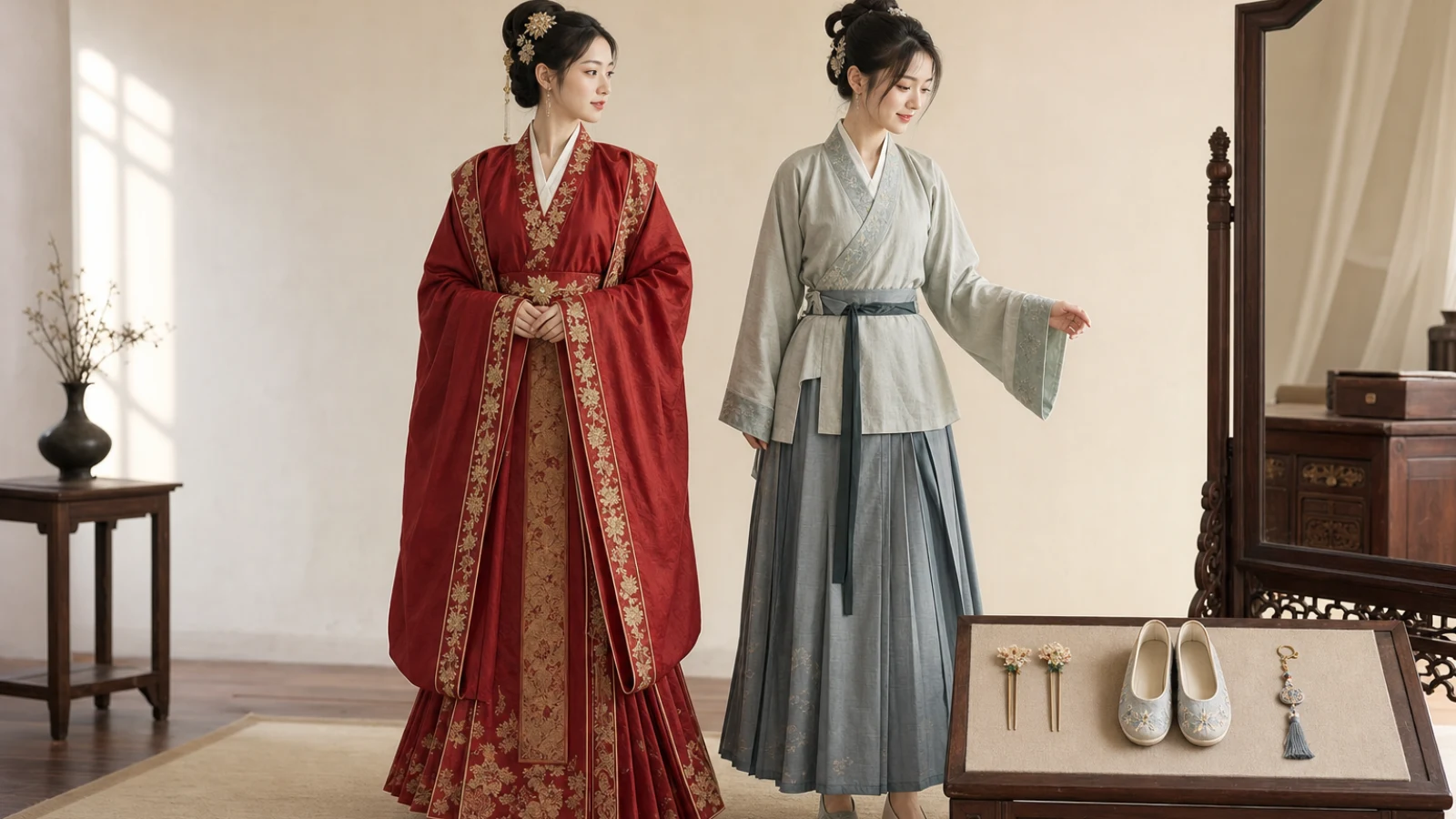
The short answer: as a guest at a Chinese or Chinese-Western wedding, skip white and ivory. If the wedding includes any Chinese ceremony, skip red as well. Large sleeves are not off-limits. They belong to lawns, gardens and outdoor ceremonies. Indoors, where you will dance, hold a glass and sit at a long table, a structured ma mian skirt with a formal jacket is the easier garment to wear. What follows covers only that boundary: color, and how much movement the sleeve and hem actually allow. Bride styling is a separate subject.
Why guests get stuck on color first
Guest color rules are not one rule. Two are stacked. White and ivory are the bride's colors at a Western wedding. Red is the bride's color in Chinese tradition. A ceremony that pairs vows with a tea service switches both on at once.
So the instinct that red means festive is the wrong instinct at someone else's wedding. Red and gold is used as a festive pairing now, but that is a contemporary styling choice, not evidence that every historical wedding custom looked that way. A guest in red moves the visual center of the room onto herself.
What survives both bans is a wide field: dusty rose, sage, sky blue, lavender, gold, emerald. These hold layers in a garden and do not go grey under ballroom lighting.
The reliable move is one question. When the wedding has Chinese elements, ask the couple whether red is reserved for the two of them, and whether ivory counts as white at their ceremony. That answer beats any guide, and it costs one message.
Embroidery is the other guest signal. A formal embroidered piece reads as occasion wear; a simplified, unadorned one reads as casual. If you plan to dance, keep the dense stitching on the jacket or the cuffs rather than across the whole skirt.
Garden sleeves vs. indoor dancing: the line is the floor plan
A large-sleeve fairy set is the most visually dramatic option and works best at an outdoor garden wedding, where the sleeves have room to be seen. The outer layer is usually a light, draping fabric over a fitted inner top. The volume is the point, and wind is the special effect.
Indoors it becomes a different garment. Wide cuffs find table edges, candle holders, chair backs and other people's glasses. Every lift of the arm turns into a small negotiation during the meal, during toasts, during photographs.
For indoor formal weddings where flowing sleeves are impractical, a structured ma mian skirt with a formal jacket is the practical combination, and the one that survives dancing. Flat door panels keep the front of the skirt reading straight; the pleats open as you walk instead of flying.
Fabric decides how the whole thing behaves in wind. Light gauze and crepe move well and also catch on chair backs and jewelry. Heavy jacquard and gold-woven cloth hold their shape and refuse to lift, at the cost of weight and heat. In a heated ballroom where you plan to dance all evening, a heavy gold-woven ma mian turns into weight on the hips. On a windy lawn with walking shots, the light fabric keeps wrapping around your legs. Neither is universally right. The only useful question is which surface you will stand on, and for how long.
Who should not buy what: anyone planning to dance most of the night should not buy large sleeves. Anyone who runs hot, or who is heading into a hotel ballroom with strong heating, should not buy a heavy gold-woven ma mian. Anyone travelling by public transport with a garment bag should reconsider both.
| Setting | Sleeve | Skirt |
|---|---|---|
| Lawn, garden, outdoor ceremony | Large sleeve works; wind helps | Light ma mian or ruqun; watch grass and mud |
| Ballroom, long-table dinner | Narrow or straight sleeve is safer | Structured ma mian with a formal top |
| Dancing, toasts, hours on your feet | Avoid wide cuffs | Gold-woven ma mian with a re-tightenable band |
| Outdoor ceremony then indoor reception | Photograph in the large sleeve, change at the door | One ma mian underneath is simplest |
What "danceable" means for a ma mian skirt
Hem. The edge should sit above the shoe so you are not stepping on it. Height alone will not settle this. Measure with the shoes you will actually wear, because a flat and a five-centimeter heel leave the hem in two different places.
Waistband. The ties need enough slack to be tightened a second time after dressing. A skirt that slides after ten steps is usually not the wrong size; it is a band with no reserve.
Band height. A high band and a natural-waist band allow different amounts of leg lift. If you plan to dance or take stairs, a lower band gives more room.
Weight. Heavy cloth resists wind and also resists you. Turn once on the spot, climb a flight of stairs, sit down and stand up. If you do not have to adjust the skirt afterwards, it passes.
Four things to settle before you pay
Skirt width is not your waist measurement. Hanfu skirts are often listed by flat width, and that width still needs ten to twelve centimeters of overlap for the ties to hold once it is wrapped around a body. Choosing by waist size alone is how people end up with a skirt that will not close securely.
Chinese sizing runs small. First-time overseas buyers are commonly advised to go up one or two sizes from their Western size, and shops do not phrase this identically, so send body measurements instead of a letter size.
Send height together with the heel you plan to wear. The same skirt sits differently over flats and over heels, and on grass that difference is the gap between walking and dragging.
Send the date and the venue type. Lawn, ballroom, air conditioning, a long staircase: each one changes which fabric and length make sense.
One cost is worth pricing in advance. Our storefront header lists seven to twelve days worldwide shipping and returns that travel back to China. A size exchange is a parcel in both directions, not a swap at a counter. Measuring first is cheaper than exchanging later.
Pick a guest set, not a bridal set
Step around the bridal rail first. Our wedding sets category carries crimson and wine-red ceremonial pieces built for the ceremony and the couple. If your job that day is to avoid red, that is the wrong first page to open.
The guest route is plainer. Take a ma mian skirt in a color that is neither red nor white, then add a formal top. Or take a full ruqun with an outer layer. Whether a top is formal enough comes down to three things: a standing or cross collar, a long sleeve, and a woven pattern or embroidery. A plain knit top over a ma mian pulls the outfit back to daily wear, which reads worse at a wedding than being slightly overdressed.
If color or size is still unclear, ask before you order: a flat-lay photo of a top that fits you, your measurements and your heel height say more than "I usually wear a medium." Send them through contact. For how the same wardrobe splits between ceremony and festival days, read wedding and festival styling; that piece covers ceremony weight and standing time, not guest color.
A wedding guest only has to make three decisions: color that clears white and red, a sleeve that matches the floor plan, and a size based on measurements and heel height. Once those are fixed, the rest is selection. The formal direction sits in wedding sets, the guest-friendly route in ma mian skirts, and size questions go straight to us before you pay.
FAQ
Can a guest wear red hanfu to a Chinese wedding?
Not when the wedding includes Chinese elements. Red belongs to the bride, and a guest in red pulls the room's focus away from the ceremony. White and ivory are out for the same reason at a Western-style ceremony. If you are unsure, ask the couple whether red is reserved for the two of them.
Can I wear large sleeves to an indoor reception?
You can walk in wearing them, but they are poor company for a whole evening of dancing. Large sleeves earn their keep at a garden ceremony and in lawn photographs. Once you are at a long table with a glass in your hand, the wide cuff keeps finding things to knock. Photograph in the large sleeve and change into a ma mian at the door, or start with the ma mian and a formal top.
Can I buy only a ma mian skirt and use a top I already own?
Yes, provided the top is formal: a standing or cross collar, a long sleeve, and a woven pattern or embroidery. A plain knit or a sweatshirt drops the whole outfit back to casual, and at a wedding that reads worse than being slightly overdressed.
What should I send the shop before ordering?
Your waist and bust measurements, your height, the heel height you plan to wear, the wedding date, the venue type, and one question about whether hairpieces are included. Skirt width is listed as a flat measurement and needs ten to twelve centimeters of overlap once wrapped; Chinese sizing runs small, and first-time buyers are commonly told to go up one or two sizes.
References
Sources were used to check facts and practice, not to borrow claims; no price, sales or ranking figures appear in this article.
- Olive Girl — Hanfu Wedding Dress: The Complete Guide for Brides and Guests (2026-06-14) — retrieved 2026-10-23T18:31:09+08:00
- Yunavelle — Hanfu Photoshoot Outfits: Styles, Colors & Practical Tips (2026-10-12) — retrieved 2026-10-23T18:31:12+08:00
- Nüwa Hanfu — Store FAQ — retrieved 2026-10-23T18:31:13+08:00