
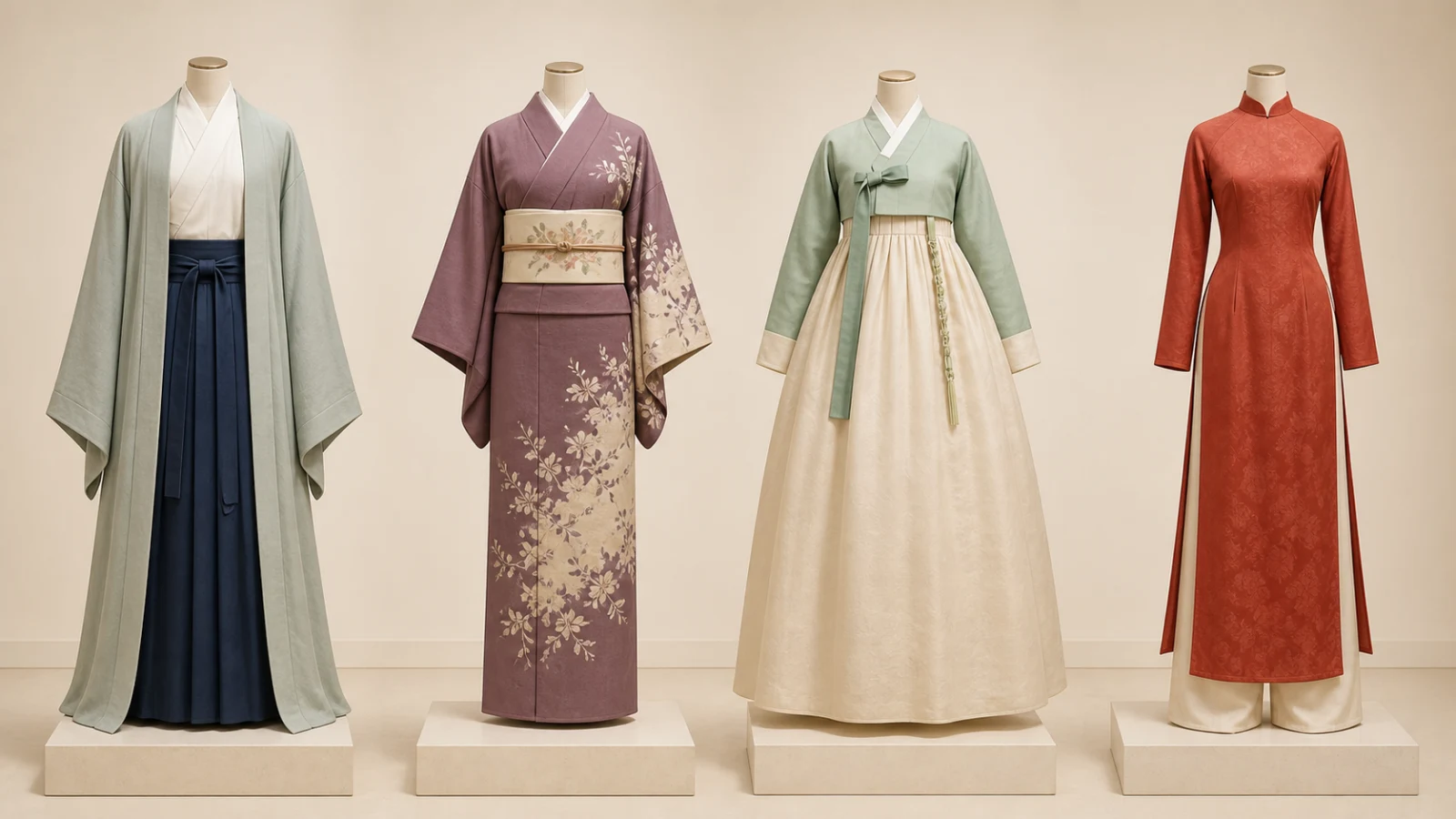
Many readers first meet kimono, hanbok, áo dài and Hanfu comparison through a photograph, a product name, or an occasion they need to dress for. A useful guide looks past that first impression and connects visible construction, material, fit, movement, and context so the final choice still makes sense away from the campaign image.
Begin with each tradition’s own name
These traditions belong to different historical and national or ethnic contexts; exchange and visual overlap do not make their names interchangeable. Traditional dress should first be understood in the terms used by its own community, collection, or scholarship. Place, date, wearer, garment pieces, and occasion belong to the description; a global category or translated shopping keyword is too broad to carry that work.
Before choosing kimono, hanbok, áo dài and Hanfu comparison, define the real occasion, the hours of wear, the expected movement, the climate, and the points that cannot be compromised. Each clothing tradition needs its own local name, source, construction, material history, and social context. Starting from those needs prevents an attractive photograph or a familiar label from making the decision on the reader’s behalf.
Compare garment systems, not silhouettes alone
Observe kimono straight panels and obi, hanbok jeogori and high-waist skirt, áo dài tunic and trousers, and Hanfu lapel and upper/lower systems. Visual comparison is most useful when it follows the same structural question on both sides: wrap direction, panel, closure, layer, waist control, sleeve, or dressing order. Comparing one garment’s construction with another garment’s colour produces a resemblance, not an explanation.
Read a page about kimono, hanbok, áo dài and Hanfu comparison from the whole garment toward the details: front, side, back, opening, inner layers, fastening, measurements, and included pieces. A close-up may be excellent for embroidery yet useless for judging proportion. When views disagree, the complete structure deserves more weight than the most dramatic image.
| Local term and source | Comparable construction dimension | Non-comparable context |
|---|---|---|
| Garment system | Each tradition’s own term plus full views of pieces, closure, layering, and dressing order | Visual resemblance is treated as shared identity or origin |
| Material and making | Fibre, weave, dye, surface technique, maker/place, and object date for each side | A single Chinese textile source is used to explain another tradition |
| Social use | Who wears it, where, when, and under whose guidance | Religion, gender, colonial history, or living protocol is reduced to style |

Materials need sources on both sides
Fibre, weave, dye, embroidery, surface work, and maker knowledge need attributable sources for every tradition being discussed. A Chinese textile source can illuminate the Chinese garment, but it cannot silently stand in for the history or technique of another community. kimono, hanbok, áo dài and Hanfu comparison must also work away from the camera. Try the planned underlayers and shoes, then sit, walk, climb a step, raise both arms, and repeat the longest action required by the occasion. A small imbalance at the waist, collar, cuff, or hem often becomes obvious only after several minutes of movement.

Use and social context matter
Who wears a garment, in what season, for which work or ceremony, and under whose guidance can matter as much as the cut. Religion, gender, migration, trade, colonial history, revival, and contemporary fashion should not be flattened into a decorative style board. When a key fact is absent, treat that absence as a practical risk: it may affect fit, classification, care, delivery, or return. One limitation deserves particular attention here: Grouping them as “Asian costume” or identifying by neckline alone erases internal variation and misplaces images. Ask for a measurement, material line, construction photograph, date, or policy instead of relying on a confident adjective.
Similarity does not prove shared origin
Use neutral construction terms in comparison, introduce each by its own name, region and occasion, and label sources even in mixed styling. Trade and cultural exchange can produce meaningful connections, yet a similar wrap, motif, or textile does not prove common origin by itself. A responsible comparison states the limited similarity, the important difference, and the evidence that would be needed for a stronger historical claim.
The value of kimono, hanbok, áo dài and Hanfu comparison becomes clearer after imagining the second and fifth wear, not only the arrival-day photograph. Consider cleaning, storage, simple repair, compatibility with existing layers, and whether the piece can serve more than one appropriate setting. Repeated comfortable use is a stronger measure of value than decorative density alone.
Return to local terminology
The conclusion should return every garment to its local name and context rather than ranking age, authenticity, or cultural value. Readers gain more from understanding how each clothing system works than from being told that one is a version of another. A Hanfu or Chinese-textile source supports only the Chinese side of kimono, hanbok, áo dài and Hanfu comparison; every other tradition needs its own attributable source and context.
A sound decision about kimono, hanbok, áo dài and Hanfu comparison should remain easy to explain: what the garment or offer actually is, why it suits the intended use, which limitations still matter, and what must be checked again at purchase or before dressing. If that explanation depends on guessing a hidden structure or policy, the uncertainty is still part of the choice.