Ordering hanfu across a border starts with one decision before style or color: size. Chinese brands usually mark garments by height plus bust or waist, not by a universal S/M/L. The letters exist for convenience, but the centimeters behind them differ from brand to brand and from Western sizing. The industry agrees on this in a single sentence. Yandan Hanfu's beginner guide puts it in writing: "Check the size guide carefully — Hanfu sizing often differs from Western sizing; measure your bust, waist, and height." This article turns that line into steps you can use today: how to take three home measurements, a reference table for converting between Chinese and US/EU sizing, style-by-style selection tips, a pre-order checklist, and what to do if a size still misses. One thing up front: everything below is a general range. Actual numbers vary by shop and by garment, so always trust the size chart on the product page you are ordering from.
1. Why Chinese sizes don't line up with US/EU letters
Western fast-fashion uses S/M/L or numbered cuts such as 4/6/8, built around bust, waist, and hip, so the letter drifts as your body changes. Chinese hanfu follows a different logic: the length of a full-sleeve robe is set mostly by height, while the width of a mamian skirt or a ruqun depends mainly on waist and skirt length. A women's S from one Chinese label might mean "height 155–160 cm, bust 78–84 cm" — that is normal. But the same brand's M in a stand-collar robe might be listed as "height 160–165 cm, bust 84–88 cm." The two sizing systems do not run parallel, so translating a Chinese S straight into a US S usually misses.
There is also "ease" to account for. Hanfu is cut loose so a robe drapes and overlaps, and many styles add several centimeters of room beyond the raw bust — roughly +3–6 cm, more on wide garments. A piece is therefore often larger than the bare measurement on its tag. Shop by the garment's actual body and skirt length, not just the letter.
2. How to measure: bust, waist, height
You need a soft tape measure and a mirror. Wear fitted undergarments, stand straight, stay relaxed, and breathe normally.
- Bust: wrap the tape around the fullest part of the chest, level and snug but not tight. Record the reading at exhale and inhale, then use the middle value.
- Waist: measure the narrowest point (usually just below the ribcage), relaxed, without sucking in.
- Height: stand barefoot against a wall, align the top of your head with a horizontal line, and record floor-to-crown. For large sleeves or robes, also note arm span and full-sleeve length.
Keep the tape parallel to the floor and read from the front to avoid parallax error. A second person helps with accuracy. Save the numbers in your phone notes so they are at hand at checkout.
3. Reference conversion table: XS–XXL by height and bust
| Chinese size | Typical height | Typical bust | ~US/EU reference |
|---|---|---|---|
| XS | 155–160 cm | 78–84 cm | US 2–4 / EU 34–36 |
| S | 158–164 cm | 82–88 cm | US 4–6 / EU 36–38 |
| M | 162–168 cm | 86–92 cm | US 6–8 / EU 38–40 |
| L | 166–172 cm | 90–96 cm | US 8–10 / EU 40–42 |
| XL | 170–176 cm | 94–100 cm | US 10–12 / EU 42–44 |
| XXL | 174–180 cm | 98–104 cm | US 12–14 / EU 44–46 |
Treat this table as a starting point, not a constant. Grading varies by brand, and many shops publish a garment-specific "flat measurement" chart; use this only to narrow your range, then confirm on the page you are buying from.
4. Style-specific measuring differences
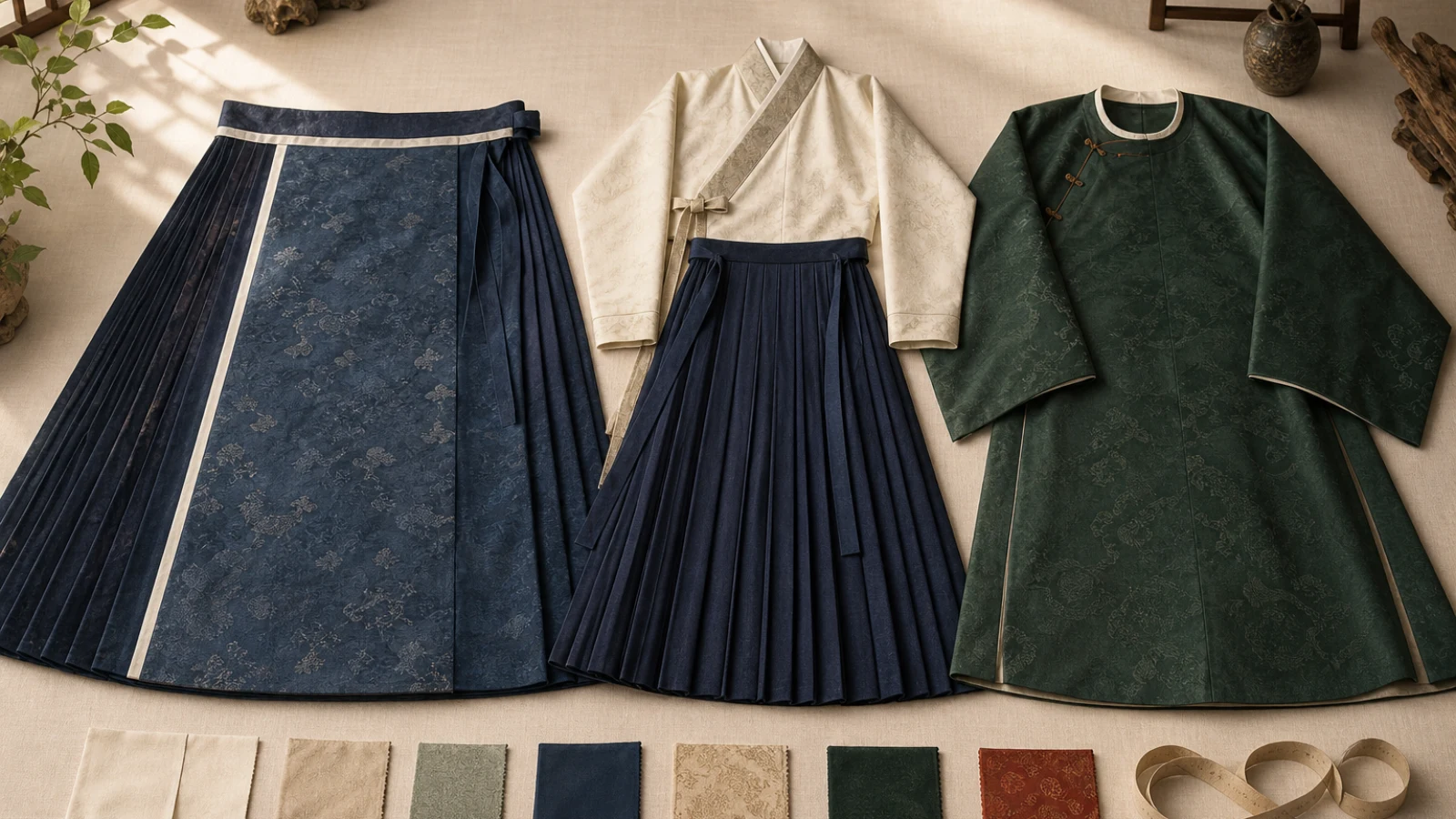
- Ruqun (top + skirt): the top is driven by bust and sleeve width; the skirt by waist and skirt length. Two-panel styles also depend on how the waistband sits.
- Mamian skirt: waist and skirt length are the two key numbers. Measure from your waist to the hem height you want, keeping in mind the top you plan to pair it with.
- Long robe / shenyi: focus on body length (shoulder to ankle), full-sleeve width, and bust. Robes carry more ease, so avoid sizing up just to be safe.
If you are unsure, send your real numbers with a photo of the style to the seller and ask for a recommended size for that specific piece.
5. Cross-border pre-order checklist
Before you pay, run down this list:
- Have you read the size chart on the current product page and compared it with your own bust, waist, and height?
- For multi-measurement garments (like skirt sets), did you check both waist and skirt length separately?
- Did you note the ease / fit allowance, and which column matches the fit you actually want?
- Did you confirm a recommended size with support and keep the conversation for reference?
- When in doubt, prefer a seller who clearly supports size exchanges or reshipment.
6. If you ordered the wrong size
On a cross-border order, return shipping, customs duties, and the extra transit time often add up to a large share of the item price. Many shops state plainly that a wrong size chosen by the buyer is not covered by free returns or exchanges. Spend an extra five minutes measuring and comparing before you order — it is cheaper than fixing it afterward. If a piece truly does not fit, contact the seller early to discuss an exchange rather than leaving it unresolved.
FAQ
Q: I only know my usual US/EU size — can I use it directly for hanfu? A: Not directly. Use the table above to narrow your range, then verify against the specific product page's chart.
Q: My height falls between two sizes. Which do I pick? A: Weight the core measurements (waist, skirt length) more than height, and check the style's ease. Between two close options, sizing up slightly is usually safer than too tight — but not so much that you lose the silhouette.
Q: What about children or unusual proportions? A: Most brands grade by height plus bust. When unsure, send your real numbers to support and ask for a recommendation.
Q: The same style is offered in standard and plus versions. How do I choose? A: Use the measurements each version lists on the current product page; do not mix numbers from the other version.
Measured up but still stuck between two sizes? Send your bust, waist, and height to the Changan Hanfu team and let us confirm a size for you. Head to the contact page on this site.