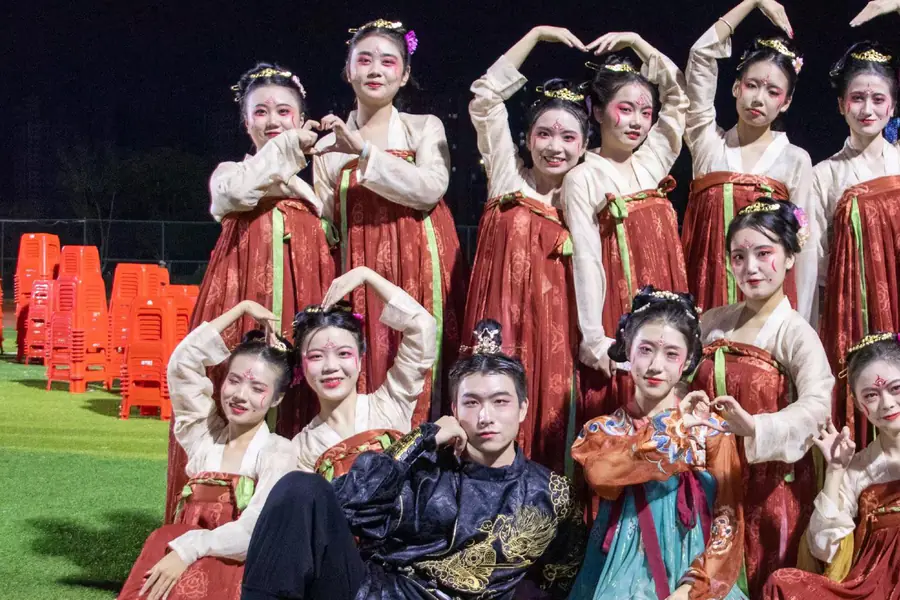
Hanfu for Beginners: How to Wear the Layers Step by Step
Unwrapping a new multi-layer hanfu set can feel like being handed a puzzle: several identical-looking rectangles of cloth, no labeled order, and the fear of getting it wrong in front of other people. The entire method compresses into one rule: inner layers first, then outer; settle the top before the bottom. Concretely, you put on the base robe first, wrap the skirt next, add the outer jacket over it, fix the crossover collar, and finish with the sash. This guide turns that rule into a routine you can follow with the box still open: unpack and identify the four pieces, dress inside-out, set the collar correctly, tie the sash, then run a final mirror check. After you have done it twice, it becomes muscle memory.
1. Unpack and identify the pieces
Sets vary, but a typical set ships with four core items: an inner robe (中衣), an outer jacket (上襦 or 外套), a skirt (下裙), and a sash or ties (腰带/系带); some add a sheer trailing sash (披帛). Before anything touches your body, lay each piece flat and sort it by how close to the skin it belongs:
- Inner robe (中衣) — the base layer, worn against the skin, reaching the wrists and ankles. It absorbs moisture and stops the heavier outer robe from sticking to you or chafing.
- Outer jacket (上襦) — a short top, either wide-sleeved or narrow, worn over the inner robe.
- Skirt (下裙) — a mamian skirt or a ruqun skirt. The upper band rests at the waist (or higher for a high ruqun); the gathered body falls to the hem.
- Sash and ties (腰带/系带) — the broad belt cinches the waist; thin cords tie the collar and the skirt band.
2. Dressing order, step by step
Why insist on inside-first? Because once the outer layers are on, fixing a twisted inner layer means undressing. Doing the foundation first keeps everything smooth on top. Work through these seven steps, one action each:
- Lay it out. Identify which piece is inner and which is outer; smooth creases and confirm front versus back (the tag or row of stitches reveals the back).
- Put on the inner robe. Slip it on and pull the hems level. If the collar is a crossover style, set it correctly now (step 5).
- Fasten the skirt. Hold the band at both ends, wrap it around your waist — or your chest for a high ruqun — center the flat panel (裙门) of a mamian skirt on your midline, and knot the side ties. Check that the hem hangs true.
- Add the outer jacket. Slip it over the inner robe and let the two front panels fall naturally before you shape the collar.
- Form the crossover collar. Pull the left front panel across your chest and lay it on top of the right panel, so the neckline slopes toward your right side.
- Tie the sash. First the thin cord at the collar (under your right arm or at the shoulder), then the broad belt at the waist. Knot at your side so the front stays smooth.
- Do a final check. Shoulders even, no twist, nothing straining, and a skirt hem level front and back. Then sit, raise your arms, and take three steps.
A note on sleeves: long, wide sleeves like the pipa sleeve (琵琶袖) or daxiu (大袖) will catch on table edges. If you will be eating or working, roll them up toward the forearm and tuck the trailing fold, or reach for a set with narrower sleeves for the occasion.
3. The crossover collar (交领) and how to tie the sash
The collar is where most beginners get lost. Remember one phrase: left panel over right. Draw the left side of the front across your chest and lay it over the right side; the collar line then runs diagonally down toward your right hip. The reverse — right over left — is named 左衽, historically associated with mourning or the deceased, so avoid it for daily wear.
Two knots matter. The thin collar cord fixes the neckline shape; it usually lands at the right shoulder or armpit and should be snug enough to hold the fold. The broad sash creates the waistline and cleans up the silhouette; wrap it once around, pull it taut, and knot at your side, tucking the loose end under the loop so nothing bulges at the front.
4. How the styles differ: mamian skirt, ruqun, and shenyi
The general order works for most sets; the details change with the cut:
- Mamian skirt — it carries a flat panel (裙门) at the front and the back. Center the front panel on your midline, draw the deep knife pleats together from the side, and tie the side cords. The width lets you take long strides without tripping.
- Ruqun — it exists in two rises. High-chest (齐胸) anchors the skirt band above the bust and lifts the line of the outfit; waist-tied (齐腰) sits on your natural waist and reads as more everyday. Either way, seat the band firmly before tightening so it cannot slide.
- Shenyi — a single continuous robe instead of a separate top and skirt. The curved-wrap version (曲裾) winds the extra hem around your legs and locks it with cords; the straight version (直裾) hangs as a straight tube and only needs a waist sash.
5. A quick self-check list (do these at the mirror)
- The collar slants down toward your right; both lapels are equally wide; you are not accidentally wearing 左衽.
- The inner robe peeks out only at the wrists and the neck; the outer jacket covers most of it.
- The skirt hem is level front and back, and the sash feels neither loose nor biting into your ribs.
- You can sit, lift both arms, and stride a few steps without anything catching or bunching.
- The sash knot lies flat, and its tails do not flop past the hem.
6. Common mistakes and how to position any set
Beginners usually hit three walls. They treat 左衽 as a fashion choice. They mount the skirt backward, so the flat panel ends up on the back instead of the front. And they assume every set includes an inner robe, when a plain ruqun may ship without one. The fastest way to position any set is one question: is it separate pieces or a single robe? A separate top-and-skirt follows the seven steps above; a one-piece shenyi only needs you to locate the sash points. If you are still unsure, photograph your lay-flat and worn versions side by side with the product images — most mismatches turn out to be simply whether to add an inner layer.
FAQ
- What if there is no inner robe? Use a plain high-neck undershirt or camisole in white; keep the sleeve cuffs from showing.
- Which way does the skirt panel face? On a mamian skirt the flat front panel — the 裙门 — faces forward along your midline.
- My sash keeps coming loose. Tighten it before knotting, tie a double knot, or wrap the belt an extra turn around your waist.
- Can I wear this to work or a hike? Fitted, narrow-sleeve styles carry better through the day; for outdoor activity add a fixed waist belt for security.
A well-worn set moves with you. The real test is not the photograph — it is walking, bowing, and sitting through a long day without constant adjustment. Practice once at home and you will be able to dress in minutes. Still unsure about a particular set? Send us photos of the pieces laid flat and on you, and we will walk you through each layer step by step. Contact Changan Hanfu.