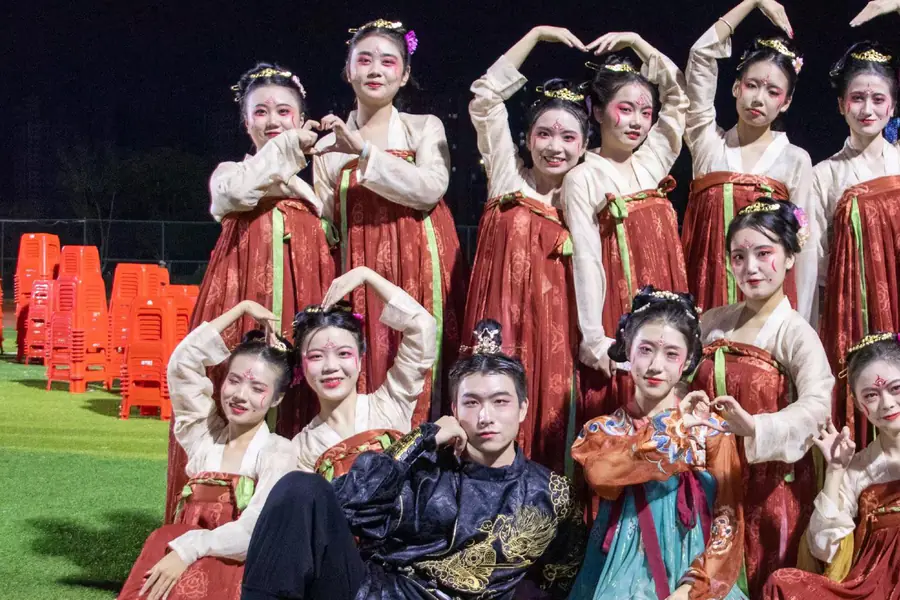
How to Identify a Hanfu Style & Dynasty at a Glance
What is this costume style called and what's its origin? A user on Reddit's r/Hanfu community recently posted exactly that question along with a photo. It is one of the most common questions every beginner asks when they first encounter hanfu: given a single garment, how do you reverse-engineer its style name and the dynasty it belongs to?
The good news is that you do not need to memorize a large glossary. There is a reproducible path: look at the collar first, then the lower garment, narrow things down with sleeves and hem length, and finally match against a dynasty reference chart. Below is a guided self-check handbook arranged in that order.
1. Start with the Collar: Half the Answer
The collar is the single most efficient first-glance cue. Four collars dominate hanfu:
- Jiaoling (crossed collar): the lapels cross in an X shape over the chest. It is the oldest and most widespread collar, in continuous use from the pre-Qin era through the Ming dynasty, and the default image most people have of hanfu.
- Zhiling (straight collar): an open front-opening with vertical lapels that do not cross. Classic on Song-dynasty beizi and Ming bijia outer garments, mostly for women.
- Yuanling (round collar): a round, closed neckline, common on male dress after the Tang dynasty, such as the Tang yuanling pao (round-collar robe).
- Shuling (stand-up collar): a raised collar that encloses the neck, appearing and spreading only late in the Ming dynasty, for example the Ming shuling ao.
Key point: a collar alone rarely settles the dynasty — the crossed collar spans many eras. However, a round collar points to Tang or later, while a stand-up collar almost certainly signals Ming. The collar is your fastest elimination tool.
2. Then Look at the Lower Garment: Ruqun · Mamianqun · Shenyi
Below the waist, the structure decides the other half of the answer. Three core options:
- Ruqun: a short top (ru or shan) paired with a skirt — the most basic two-piece combination across Tang, Song, and Ming.
- Mamianqun: a skirt with a flat, smooth front panel and dense pleats on both sides — the signature lower garment of the Ming dynasty and highly recognizable.
- Shenyi: a one-piece robe where the upper and lower parts are cut and joined as one, the mainstream form of the pre-Qin and Han era, revived many times since.
Consequently: seeing a mamianqun points almost directly to Ming; seeing a shenyi points to an earlier era, roughly Han and before.
3. Use Sleeves and Hem Length to Narrow It Down
Sleeve type is the second discriminator:
- Large sleeves (daxiu): wide and flowing downward, typical of Wei-Jin elegance, Tang formal attire, and Ming grand robes.
- Narrow or small sleeves: fitted or slightly tapered, mostly everyday wear.
Hem length also helps: a bust-height (qixiong) silhouette such as the Tang qixiong ruqun carries a strong period signal, while an ankle-length robe ties more closely to traditional ceremonial norms.
4. Quick Dynasty Reference Table: Tang · Song · Ming
| Dynasty | Typical collars | Main styles | Signature details |
|---|---|---|---|
| Tang | Crossed, some round | Qixiong ruqun, yuanling pao | Large sleeves, scarf (pibo), opulent look |
| Song | Straight popular, crossed persists | Beizi, duijin shan | Narrow sleeves, restrained and slim |
| Ming | Crossed and stand-up | Mamianqun, shuling ao, bijia | Buttons, collar guards, strict regulation |
Please note these are typical features, not iron laws. Within each dynasty there are regional differences and gradual changes, and informal dress often differs from textual records. Do not reject every exception because of a single template.
5. Stage Costume vs Hanfu in One Sentence, Plus a Term Fix
In one line: hanfu seeks evidence-based reconstruction of historical forms, while stage costumes exaggerate and mix freely for theatrical effect. Hanfu respects the internal logic of collar, body, skirt, and sleeve; stage costume permits spectacular, historically loose combinations.
One frequent misunderstanding deserves correcting: people often treat hanfu and ancient costume as the same thing. Ancient costume is a loose term for props and clothing in film and drama; hanfu refers to a systematic, community-consensus effort to reconstruct the traditional forms of Chinese dress.
6. A Self-Check Checklist for a Single Photo
- Note the collar: crossed / straight / round / stand-up?
- Note the lower garment: skirt, trousers, or a one-piece robe? If a skirt, does it have a flat front panel and side pleats?
- Note sleeves and hem: large or narrow? Bust-height or knee-length?
- Match against the dynasty table: feed the three cues into Section 4.
- Add fine details: patterns, buttons, and accessories refine the guess.
FAQ
Q: Why does the same collar appear in multiple dynasties?
Formal evolution is cumulative. The crossed collar was a base structure preserved from the pre-Qin era through Ming, so a collar alone cannot date a garment; combine it with other cues.
Q: Is the mamianqun exclusively Ming?
It is the signature Ming lower garment, but it continued into the Ming-Qing transition and the Qing dynasty. Always judge with the whole silhouette, never a single piece.
Q: How do I quickly tell hanfu from studio/stage costume?
Check whether it follows historical structural logic: are collar, body, skirt, and sleeve consistent, and are colors and patterns free of theatrical exaggeration? If the structure breaks down, it is usually costume or fusion fashion.
Wrap-Up
Identifying hanfu is surprisingly simple: four cues, one table, one checklist. Next time you meet an unfamiliar photo, run through the steps one by one.
If you would like to verify a particular garment, or you have a picture that is hard to classify, bring us the image with as much detail as possible and let us work through it together. We enjoy helping you confirm, step by step. Contact page → https://www.changanhanfu.com/contact