Men's Hanfu Starter Guide: How to Choose Daopao, Yuanlingpao, and Yishangzhi
"What silhouette should men pick for hanfu?" is one of the most asked questions Chang'an Hanfu's support team hears from male users. Many men want to try hanfu but get stuck at step one: the market talks a lot about women's forms, and men's hanfu is reduced to a "costume robe" impression, leaving them worried it will look out of place or that there is too little to choose from. In fact, the Han male wardrobe is complete — daopao, yuanlingpao, and yishangzhi (upper garment and lower skirt) each have clear use cases. This article explains the mainstream male silhouettes, their cut differences, and gives a concrete "how to buy your first set" plan.
1. Why Men Feel "There Is Nothing to Choose": The Male-Silhouette Knowledge Gap
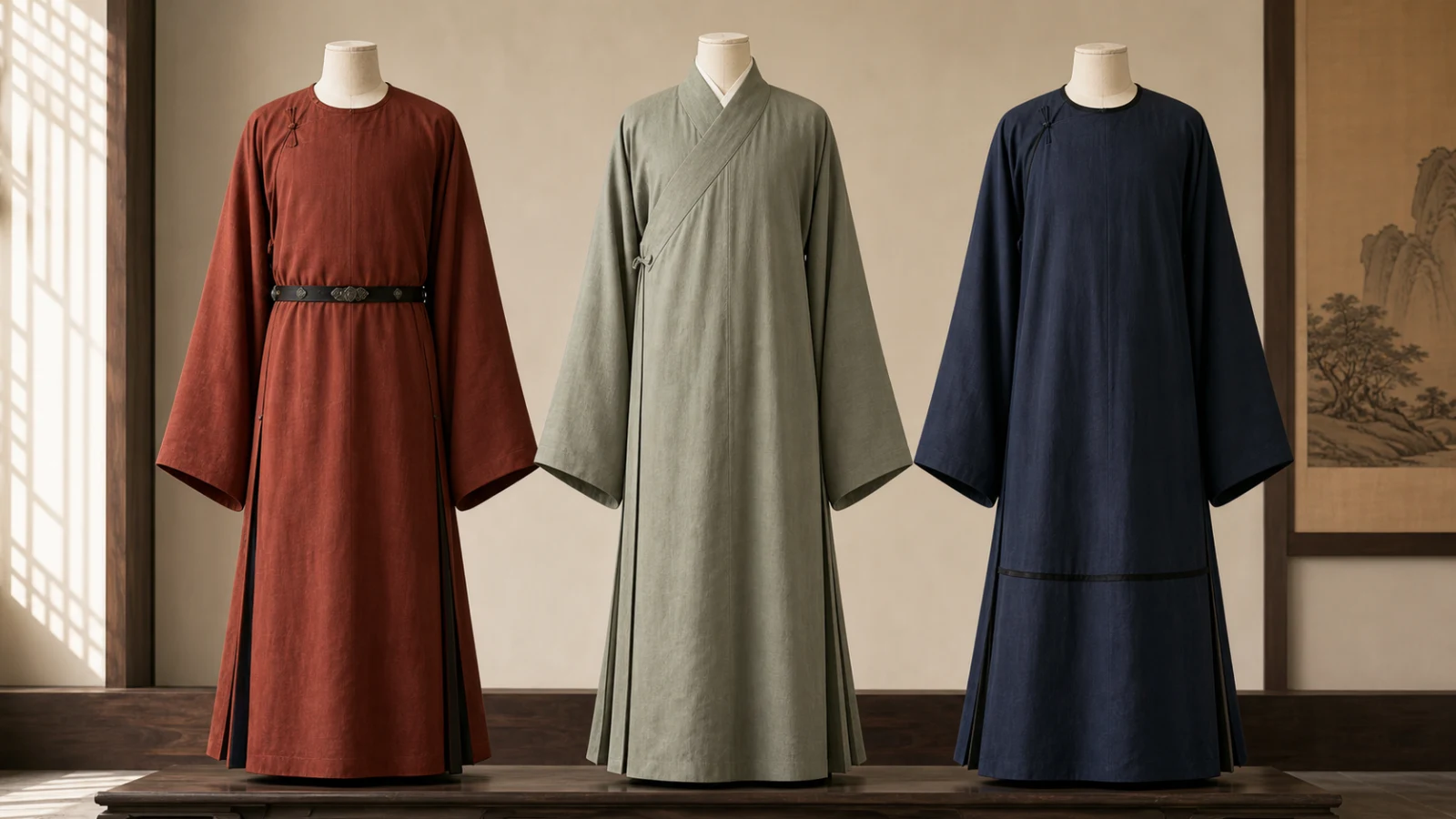
Public impression of hanfu is dominated by women's forms, and male silhouettes get little科普 (popular science) airtime, so men mistakenly think "I can only wear a theatrical robe." Actually, traditional male daily and ceremonial wear has a clear lineage: daopao is the literati's daily and gathering robe, yuanlingpao is the official and formal robe, and yishangzhi (like shenyi or separate upper-lower) is the older connected or separate structure. Chang'an Hanfu's men's line is graded along these three主线 (main lines) so you pick by occasion, not by "does it look like a costume."
- Daopao: wide robe, large sleeves, cross collar — literati feel, great for gatherings, tea sessions, daily street wear.
- Yuanlingpao: round collar, narrow or wide sleeves, neat and dignified — for ceremonies, weddings, shoots.
- Yishangzhi: upper-lower or connected shenyi — best for showing body proportion, ideal for newcomers wanting height.
2. Breaking Down the Three Main Silhouettes: Cut and Temperament
Daopao: Literati, Relaxed, Easy to Wear
Daopao is the representative Ming-dynasty literati daily robe: cross collar right lapel, gathered large sleeves, loose body, side slits with a hidden hem. Its cut is forgiving on body type — both slightly heavy and slim figures read as flowing. Chang'an Hanfu's daopao uses tencel or cotton-linen for good drape and easy care, and is our top recommendation for a first male set. A simple waist belt is enough; no complex accessories needed.
Yuanlingpao: Dignified, Formal, Sharp
Yuanlingpao (or queku pao) has a round collar and front ties or buttons, overall neater than daopao. It suits occasions needing "formality" — being a wedding role, coming-of-age ceremony, formal shoot. The cut emphasizes straight shoulders and gathered cuffs, making the wearer look sharp. Chang'an Hanfu offers plain and tonal-jacquard versions; plain is more daily, jacquard more ceremonial.
Yishangzhi (Shenyi / Upper-Lower): Tall, Authentic, Proportion-Fixing
Yishangzhi is among the oldest Han male structures. Shenyi connects upper and lower into one piece, observing "twelve panels" and "curved hem"; separate upper-lower is worn apart for more flexibility. Its cut lifts the visual center of gravity and fixes leg-to-body ratio, perfect for newcomers wanting "stand straight, look taller." The downside is slightly complex dressing — you must tie the belt and layer the middle garment well.
3. Choose by Body Type and Occasion: A Comparison Table
- Slim men: choose daopao or yuanlingpao; the loose cut adds volume, avoid overly tight shenyi.
- Slightly heavy men: choose daopao (hidden hem covers belly) or straight yuanlingpao; avoid tight yishangzhi.
- Tall men: shenyi / yishangzhi best elongate proportion; yuanlingpao also adds height.
- Daily commute: daopao + plain color is least out of place; formal: yuanlingpao or shenyi.
- Overseas wholesale: men's daily three-piece (daopao + middle garment + belt) is a popular MOQ combo.
Chang'an Hanfu suggests newcomers prioritize a "daopao + middle garment + belt" combo: high fault tolerance, simple matching, photogenic — then move to yuanlingpao or shenyi once you confirm you like it.
Color and weight also follow the same occasion logic. For daily wear, muted tones like moon white, slate blue, or deep teal read modern and pair with ordinary shoes, so the outfit does not shout "costume" on the street. For formal events, richer colors such as maroon, ink black with gold jacquard, or dark green with auspicious motifs signal ceremony without looking like a stage prop. Fabric weight matters too: a lightweight tencel daopao suits summer and indoor gatherings, while a thicker cotton-linen or quilted-lined yuanlingpao carries autumn and winter. When you message our advisor, mention the season and where you will wear it — that single detail changes the recommended fabric and color more than body type does, and it is the fastest way to avoid a set that sits unworn in the closet.
4. How to Buy Your First Set: Three Pitfalls to Avoid
- Check silhouette labeling: look for specific names like "daopao / yuanlingpao / shenyi," not a vague "men's ancient robe."
- Check size mapping: men's shoulder width and garment length matter more than women's; always verify flat-laid centimeters.
- Check fabric drape: men's cut leans on drape for temperament; stiff polyester reads cheap — prefer tencel, cotton-linen.
Men wearing hanfu was never "nothing to choose"; it needs someone to explain the silhouettes clearly. Chang'an Hanfu's men's line exists for exactly this: every form ships with a silhouette note and flat-laid photos so you buy informed.
5. Pick Your First Men's Set: Chang'an Hanfu Men's Entry
If you are still unsure whether daopao, yuanlingpao, or shenyi fits you, contact a Chang'an Hanfu advisor directly. We give one-on-one advice by your body type and occasion, and support English inquiries and overseas wholesale quotes.
👉 Contact Chang'an Hanfu for one-on-one men's hanfu silhouette advice and quotes
You can also browse flat-laid photos and silhouette notes in the men's category:
👉 Browse Chang'an Hanfu men's hanfu category
References
Pain point source for this article (real Baidu Zhidao question):