Costume and hanfu photograph alike. The difference shows up in three things you can check without a loupe: whether the waist closes with elastic or with ties, whether the listing shows the garment laid flat, and whether the seller can answer a question about construction. None of it requires you to identify a fibre by touch.
1. Start at the waist: elastic or ties
In a 2022 Sixth Tone report on the hanfu market, a buyer named Yun Qing is quoted on what archaeological work does and does not support. Her list includes Tang-style hezi and skirts, garments sold as "Wei and Jin" style, and "Song-style pants with elasticated waistbands." She also explains why those garments keep being made: they are attractive, convenient to wear, and they sell.
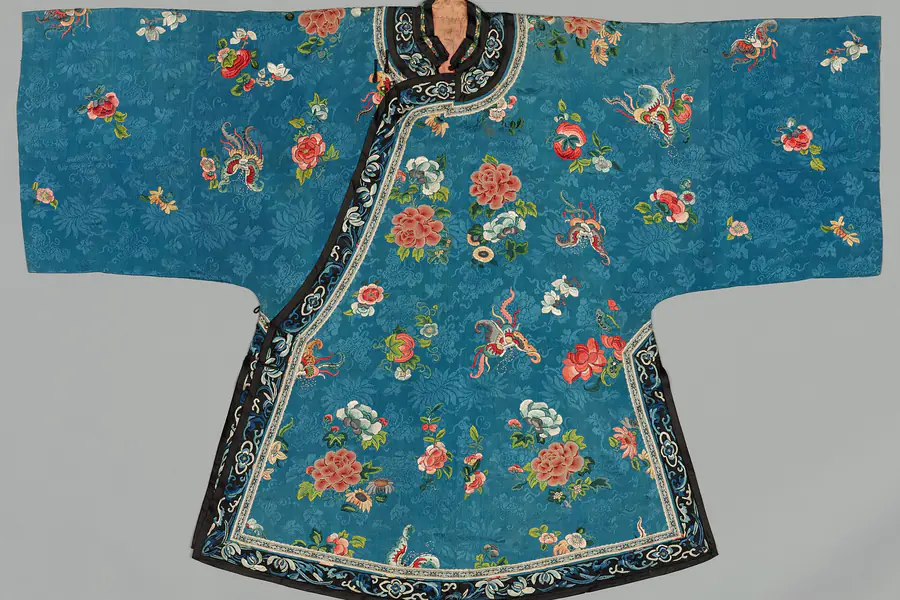
Elastic on its own is not a verdict. It is a different tailoring logic, one borrowed from modern ready-to-wear: a stretch band absorbs size error, closes in a second, and holds without ties. The construction this clothing descends from closes differently. Wikipedia's Hanfu article, describing the basic assembly, notes the crossing collar with the left front panel over the right, "fastened at the right waist (known as youren), typically by a knotted ribbon." A tie is adjustable. It also needs a waistband that can carry the tension, and someone who knows how to knot it.
So the question is not whether elastic is bad. It is which garment you are buying. An elastic-waist skirt can be a perfectly good piece of clothing. It just is not evidence of a historical cut, and it should not be priced as one.
2. Then the photographs: no flat-lay, no order
A Chinese buying guide published by aihanfu in December 2018 is blunt about this: if you cannot see the garment laid flat, do not buy it. The reason given is construction, not taste. A shop that has the form right is usually willing to show the flat-lay; if you still doubt it, put that flat-lay next to a photograph of an excavated garment and compare. The same article tells readers to check edge stitching and look for loose threads.
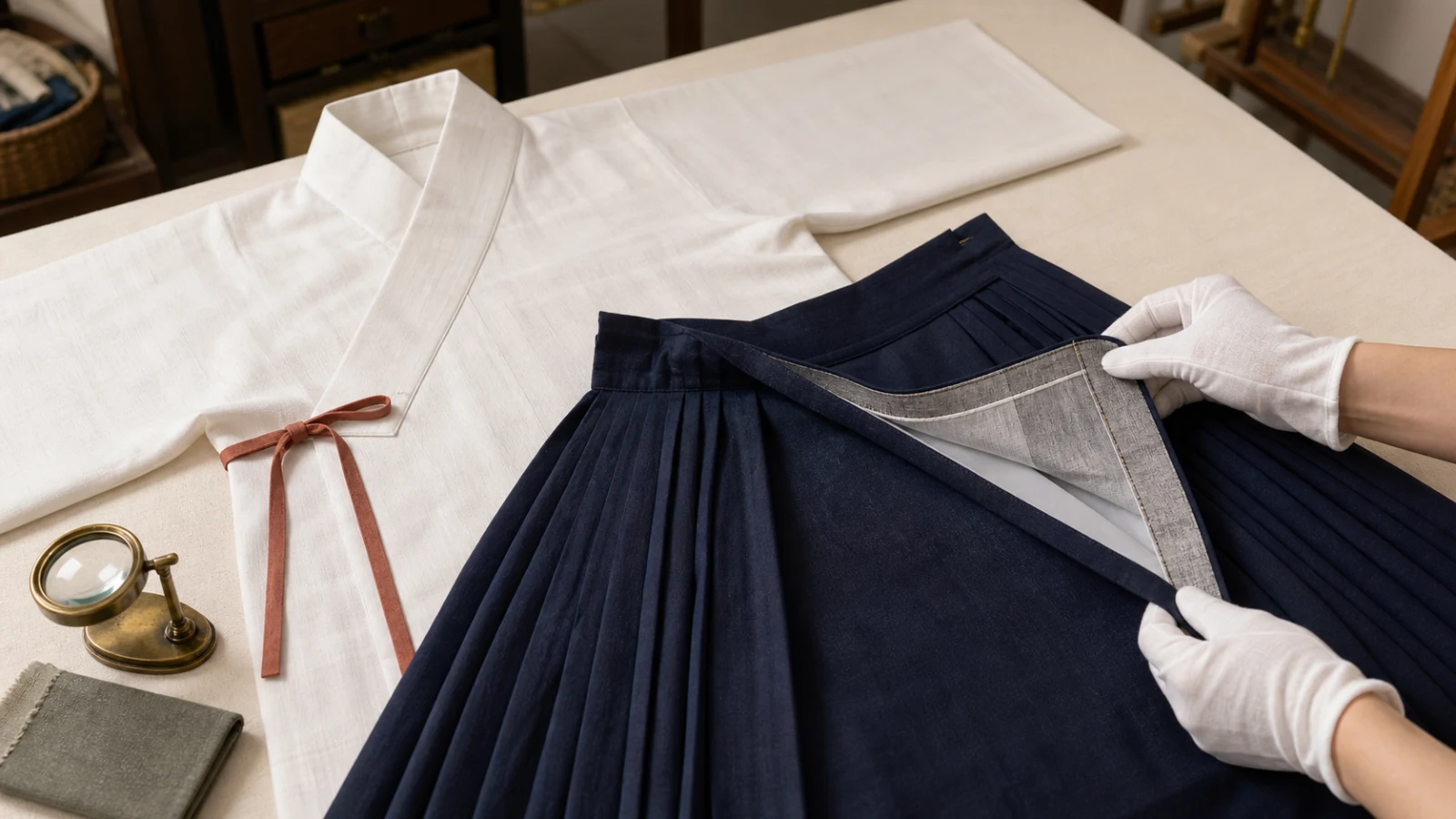
Flat-lay earns its place because a model photograph hides exactly what you need. Clips, posing and lighting can hold a garment in a shape it will not hold on you. Laid flat, you can read the silhouette, the width from sleeve root to cuff, how far the front panel overlaps, whether the waistband is one continuous piece, and whether the pleats are pressed in or merely gathered.
Sixth Tone makes the same point from the buyer's side, describing people who "buy outfits purely based on the photos sellers use online, only to receive poor quality and ill-fitting imitations."
Ask for a specific set: full front flat, full back flat, a close-up of the waistband, the cuff and the sleeve root, the overlap at the skirt front, and the lining with its seam allowances. Every missing photo is a part of the garment you are guessing at.
3. Then the questions: form and pattern
Yun Qing, in the same article, refuses to pay without a pattern: "I won't put money down if the merchant won't show me a two-dimensional pattern — otherwise, the fit is bound to be flawed." A pattern is the map of a cut. If one exists, the garment was drafted. If it does not, the listing is being sold on photographs.
Most overseas buyers will never read a pattern, and that is fine. The questions still work: which dynasty, which form; how the waistband closes; how the pleats are set and how many; how wide the front overlap runs; whether there is a lining; where the ties attach. Answers that name parts suggest a drafted garment. Answers built from "flowy" and "flattering" suggest a photograph.
One honest caveat. Where the line between hanfu and costume falls is contested inside the community, not settled. The aihanfu article, for instance, lists "Wei and Jin style," the two-piece chest-high ruqun and multi-wrap quju among the forms it considers unsupported by excavation, on the grounds that they are reconstructed from figurines and paintings rather than surviving garments. That is one publication's position, not a consensus, and plenty of shops, ours included, sell some of those forms. What you can actually test is whether a seller can explain its basis. A shop that can explain its reasoning is also a shop that can be held to it.
4. Shop by form once the checks pass
After the three checks, browsing changes order: enter through a form category instead of a keyword search. On the women's side, ruqun reads as a top-to-skirt ratio with a defined waist position; mamian reads through pleats and waistband; quju through how many times the robe wraps and in which direction; beizi through the front opening and sleeve shape. Under one keyword, these are four different drafting problems, and their size charts do not transfer.
Leave price until last. Price explains some of the making; it explains none of the form. An inexpensive duijin beizi can be an honest product. An inexpensive "Wei and Jin" set may just be a costume with a better title.
FAQ
Does an elastic waist mean it is not hanfu?
Not automatically. It usually signals modern or costume tailoring, where stretch does the work that ties and pleat allowance do elsewhere. If you want something easy to wear, that is a fair reason to buy it. If you want the form, look elsewhere.
What can a flat-lay actually show?
Silhouette, the width from sleeve root to cuff, how far the front panel overlaps, the waistband structure, how the pleats are set, and the stitching. Model photos cannot show these, because a pose holds the garment up.
What if the seller will not share a pattern?
Ask for flat measurements and a structural description instead: how the waistband closes, how wide the overlap is, how many pleats, whether there is a lining. A seller who provides neither and keeps pushing for payment is leaving the risk with you.
Where should a beginner start reading form?
Start with silhouettes by category, then compare flat-lays against photographs of excavated garments. The judgement builds faster from looking than from memorising terms.